
With over 30 years of expertise in warehouse optimisation, ERA Group recognizes the essential role warehouses play—not only within the supply chain but also in enhancing customer satisfaction.
A well-designed supply chain, with an efficient warehouse, balances cost, quality, and service, benefiting both your business and your customers. High service levels from the supply chain can set you apart in the market. Conversely, high costs or inadequate service can harm your reputation and hinder business performance.
Critical Factors for Warehouse Optimisation
1. Integrating Your Warehouse into the Supply Chain
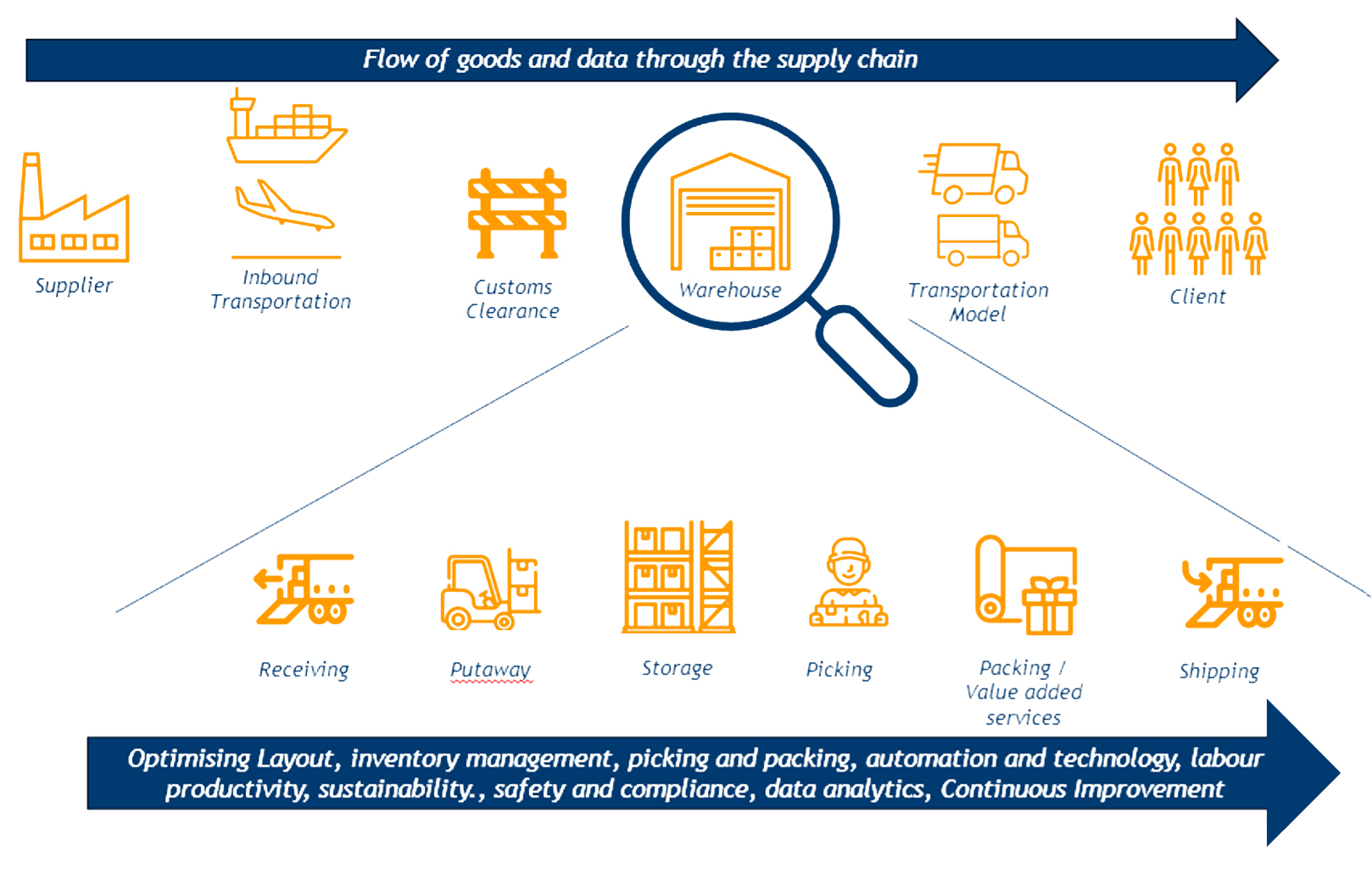
To achieve optimal performance in cost, quality, and service, the warehouse must be seamlessly integrated, both physically and electronically, with the broader supply chain. For instance, if inbound shipments are accurately processed with advanced shipment notices (ASNs), items can be promptly received, stored, and made available for sale or shipping. However, missing components create bottlenecks, raising costs and potential for error.
Generative AI now takes integration further. Receiving schedules can dynamically adjust based on external variables. If an inbound shipment is delayed due to inclement weather over the Atlantic, no problem—receiving schedules can be recalibrated automatically, minimising disruptions.
2. Optimising Warehouse Operations
While integration is vital, internal operations play an equally crucial role. Some warehouses operate well with minimal IT investment, while others continuously advance. Amazon, a leader in warehouse technology, recently announced a $1 billion investment in automation for 2024. This is in addition to the Billions that they have already invested in systems, automation, robotics and AI. Though such investments are beyond reach for many companies, the technology often filters down, enabling broader access over time.
Successful warehouses align their strategies with the overall supply chain approach, continuously assessing technology to meet both current and future needs.
3. Deciding Who Should Run Your Warehouse
A pivotal decision is whether to manage the warehouse in-house or outsource to a third-party logistics (3PL) provider. Around 50% of UK companies currently outsource their warehousing operations.
Key considerations include:
Trends in Warehouse Expansion and Market Conditions
In the UK, new warehouse builds are a familiar site on any of the main arterial roads in the UK, a trend accelerated by the boom in e-commerce, Brexit, and the COVID-19 pandemic. The majority of these are for 3pl’s to support an industry valued at £19.6 billion in 2023.
Whilst the industry is still experiencing significant growth, it’s not growing as quickly as the available capacity. Sadly, this has had inevitable consequences this year with a number of 3pl providers calling in administrators, and quite a few others unprofitable due to under-utilisation.

Considering the positive (and negative) impact that your warehouse can have on your supply chain, cost base, service offering and customer satisfaction, it is essential that it is part of your strategic planning. Especially in light of the opportunities that fast moving technology and outsourced service providers can offer.
.