




Tariffs take center stage: Manufacturers face a new era of uncertainty
The renewed tariff campaign is gaining momentum as the August 1 deadline approaches. The administration has sent letters to key trading partners—including Japan; South Korea; South Africa; Canada; Mexico; and the EU—notifying them of planned 20–50% reciprocal tariffs on a wide range of imported goods.1 For example; tariffs include 30% on EU and Mexican goods; along with 35% on Canadian imports and 25% on Japanese and South Korean products.2 As part of this strategy; sector-specific duties are also being introduced. A 50% tariff on copper is slated to take effect Aug 1; moving in tandem with proposed duties on pharmaceuticals and semiconductors that follow a brief grace period.3 So far; negotiations have yielded agreements with only the UK and Vietnam. Talks with China remain tenuous; and if no deal is reached by Aug 12; tariffs on Chinese goods will escalate.4 Commodity markets have already reacted: copper prices surged on the 50% tariff announcement; impacting manufacturers in the electronics and construction sectors.5 Meanwhile; the EU has delayed retaliatory tariffs in hopes of finalizing a deal before August.6 With cascading effects on metals; chemicals; freight; and general procurement costs; strategic action is now imperative.

KEY TAKEAWAYS: Nearly all major trade partners face new tariffs; price volatility; and sourcing disruption are imminent. Agreements finalized before Aug 1 (or Aug 12 for China) could avert some tariffs. Revisit supplier contracts and escalation terms; explore domestic and nearshore alternatives; and monitor commodity-linked price reactions.
Corrugated
North American containerboard prices have held steady through June and July 2025; showing no change from levels established earlier this year. This pricing plateau follows a late February RISI announced increase; which was implemented by most major producers in March and April. Although RISI accepted and published a $40/ton increase with their February publication; many suppliers passed along an increase of $60–$70/ton on linerboard and $80–$90/ton on corrugating medium. This was the only upward movement reported so far in 2025; according to Fastmarkets RISI.7 Since then; Fastmarkets has reported flat pricing across Q2 and into early Q3; even as recycled fiber costs began rising modestly. In May; OCC (old corrugated containers) rebounded by $30/ton; the first significant uptick after months of decline.8 While OCC shifts have yet to push containerboard prices higher; they remain a key cost driver to watch. In other industry developments; Packaging Corporation of America (PCA) is acquiring Greif’s U.S. containerboard business—two mills with roughly 800;000 tpa capacity and eight sheet feeder/box plants—for $1.8 billion. Expected to close by late Q3; this marks the third major merger among North America’s top players this year further intensifying market consolidation. Consolidation of this scale could tighten capacity buffers and influence pricing dynamics going into Q4.9 On the tariff front; corrugated itself is not directly targeted; but new U.S. trade policies are affecting recycled fiber markets; pulp inputs; and equipment sourcing. Changes in shipping dynamics—especially with China—are also impacting U.S. exports; which could subtly influence mill production strategies.10 [caption id="attachment_12862" align="aligncenter" width="428"]

Chart Data: Pulp and Paper Weekly RSI Index[/caption] KEY TAKEAWAYS: This is a perfect example of why it is critical to have packaging contracts or agreements with suppliers to prevent them from passing along higher increase rates and for true transparency in price change calculations based on index movements. We recommend reviewing packaging contracts now—particularly if your agreements do not include index-based pricing protections—and preparing for potential Q4 adjustments if fiber markets tighten further.
Lumber/pallets
The U.S. wood pallet and lumber markets have entered Q3 2025 in a state of cautious stability; with rising costs lurking beneath the surface. According to ePallet’s June 2025 market update;11 the overall tone across regions is “average;” with steady demand but persistent cost pressures from sawmill closures; rain-related logging delays; and tightened availability. The PalletTrader Q2 Market Report 12 echoes these themes; noting that nearly 60% of industry respondents expect lumber prices to rise through the remainder of 2025. Used pallet pricing is already beginning to reflect these expectations; with core costs increasing and recycled pallet inventories tightening; particularly in regions where lumber supply is constrained. Analysts also warn that if the U.S. reinstates tariffs on Canadian lumber; prices could spike an additional 15–20% by Q4.13 [caption id="attachment_12864" align="aligncenter" width="412"]

Chart Data: TradingEconomics.com[/caption] KEY TAKEAWAYS: Though Q3 lumber and pallet prices remain relatively steady; underlying cost pressures are mounting; and the risk of a late-year spike is real. With sawmill shutdowns; limited logging activity; and potential tariffs on Canadian lumber looming; buyers should prepare now for tighter supply and rising prices. ERA Group can help clients stay ahead of volatility through proactive sourcing strategies.
Chemicals & gasses
Industry-wide; chemical companies continue grappling with the ripple effects of the expanding tariff landscape. In early July; the White House unveiled reciprocal tariffs as high as 40–50% on imports of Chinese chemicals; in addition to ongoing duties on Mexico; Canada; and the EU.14 Meanwhile; upcoming tariffs on pharmaceuticals (up to 200%; with a grace period extending into 2027) are driving both near-term stockpiling and long-term reshoring investments.15 Strategic sourcing shifts are accelerating as firms scramble to escape tariff exposure. Companies are adopting “China + 1” models; redirecting purchases to India; Southeast Asia; and even domestic suppliers for HTS-exempt chains like basic olefins; where the U.S. is self-sufficient and product flows remain tariff-free under USMCA.16 At the same time; U.S. natural gas pricing—a critical input for many chemical producers—has been unusually volatile; swinging nearly $1/MMBtu in June before settling around $3.39.17 While tariff costs are rising; underlying demand for many industrial chemicals remains fragile. According to ICIS (Independent Commodity Intelligence Services); the global chemical downturn—now entering its third year—is marked by weak construction; cautious inventory strategies; and economic uncertainty. This broader softness may give buyers room to negotiate; but it also means suppliers under financial pressure may have less flexibility.18 [caption id="attachment_12865" align="aligncenter" width="509"]

Chart Data: Producer Price Index by Commodity: Chemicals and Allied Products: Industrial Chemicals[/caption] KEY TAKEAWAYS: Tariffs are pushing chemical buyers to diversify sourcing and reconsider long-term supplier relationships; especially for Chinese-origin materials. At the same time; volatile natural gas prices and continued demand softness are creating uncertainty in pricing and availability. Strategic timing and proactive negotiations remain critical as buyers navigate both margin pressure and limited supplier flexibility.
Plastics
Resin prices remained mostly flat heading into Q3 2025; with all five major commodity resins—PE; PP; PVC; PS; and PET—showing flat-to-down trends through June; according to Plastics Technology and Plastics News.19;20 Meanwhile; new U.S. tariffs are beginning to pressure the global plastics trade. Duties on Chinese plastic imports; feedstocks; and intermediate petrochemicals are increasing costs and reducing predictability for U.S. buyers. According to Sterling Plastics; these tariffs are expected to have a “slow-burn inflationary effect” as they ripple through resin conversion and logistics markets.21 Tariffs on some finished packaging goods may also limit the effectiveness of overseas sourcing strategies that helped keep costs stable during the first half of the year. Plastics News cautions that volatility could persist in late 2025; particularly if tariffs escalate further or if energy input prices (like natural gas and NGLs) spike in Q4.22 [caption id="attachment_12708" align="aligncenter" width="492"]
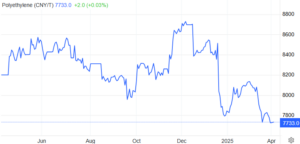
Chart Data: TradingEconomics.com[/caption] KEY TAKEAWAY: The latest round of U.S. tariffs is poised to increase costs and disrupt sourcing for plastics manufacturers; particularly those reliant on imports from Europe and Asia. With Canadian and Mexican PE and PP largely spared under USMCA; now is the time to prioritise North American resin suppliers and reevaluate international procurement strategies. Clients should prepare for potential price volatility and consider negotiating domestic supply contracts to protect margins as global trade dynamics shift.
Metals

Copper prices reached historic highs in July; driven by a new 50% U.S. tariff on imports and surging demand across electrification; defense; and infrastructure sectors.23;24;25 While the move aims to secure critical materials for national security; it also triggered widespread stockpiling ahead of the Aug 1 implementation date.26;27 Meanwhile; steel and aluminum markets remain under steady upward pressure; following the administration’s expansion of 50% tariffs in June.28 U.S. hot-rolled coil (HRC) prices recently dipped below $900/ton but are already bouncing back; with producers like Cleveland-Cliffs and Nucor issuing new target prices of $950/ton for July orders.29 Midwest aluminum premiums; though recently softer; remain elevated compared to global benchmarks.30 Scrap prices and lead times also reflect market tightness. Rebar and wire rod lead times have stretched to 6–8 weeks; with hot-dipped galvanized (HDG) and cold-rolled coil (CRC) following a similar trend.29 While some non-ferrous metals like nickel remain subdued; the broader metals environment continues to tighten; driven by policy shifts and trade disruptions that are still unfolding. [caption id="attachment_12868" align="aligncenter" width="444"]

Chart Data: BusinessAnalytiq[/caption] KEY TAKEAWAY: Copper’s surge has dominated headlines; but buyers of steel; aluminum; and rebar are also feeling the impact of aggressive tariffs and tightening supply conditions. With price premiums rising and lead times extending; manufacturers must move quickly to renegotiate contracts and rebalance inventories.
Sources:
(1) Supply Chain Dive – Trump reciprocal tariffs return Aug. 1; (2) - Supply Chain Dive – Trump reciprocal tariffs return Aug. 1; (3) Supply Chain Dive – Trump sends tariff warning letters ahead of trade deal deadlines; (4) Reuters – Trump’s tariffs spark scramble for deals ahead of August 12 deadline; (5) Barron’s – Copper prices jump as Trump’s 50% tariff shocks manufacturers; (6) The Guardian – Enduring confusion; the only certainty amid Trump’s latest tariff threats; (7) Fastmarkets RISI – Everything You Need to Know about US Containerboard Price; (8) Packaging Dive – Fiber Prices Flat in May 2025; (9) PCA agrees deal to acquire Greif Containerboard for $1.8 bln in third major containerboard M&A deal; (10) Resource Recycling – Tariff; (11) ePallet – Pallet Market Update; June 2025; (12) Packaging Revolution – PalletTrader Market Report Q2 2025; (13) Farm Credit East / Forest Economic Advisors – “2025 Forest Products Outlook: Softwood markets remain weak”; (19) Plastics Technology – June 2025: Prices for the Five Commodity Resins Flat to Down; (20) Plastics Technology – July 2025: Prices for Volume Resins Flat to Down Heading into Third Quarter; (21) Sterling Plastics – How the 2025 Tariffs Will Impact Plastic Prices; (22) Plastics News – Resin Prices May Be Volatile in 2025; (23) WSJ – Copper Prices Hit Record After Trump Unveils Steep Tariff; (24) WSJ – Five Things to Know About Record Copper Prices; (25) WSJ – Trump’s Tariffs Send Copper to Record; Dow Industrials Slip; (26) Reuters – Trump’s Copper Tariffs Pile More Metal Misery on US Auto Industry; (27) Reuters – Manufacturers Plead for US Tariff Clarity Before Copper Stockpiles Dwindle; (28) Reuters – Explainer: The Reality of Trump's Steel and Aluminum Tariffs; (29) Ferguson Weekly Newsletter – Week of June 23; 2025 ; (30) AP News – Trump's Promised Steel and Aluminum Tariffs Go Into Effect